To reproduce the case, put its notebook and accompanying inputs in the same folder. Use the Python environment set up in the installation tutorial. Start with the original parameters and compare the result with the check reported below.
Run this example yourself. The OneSimulation Runtime brings the full Python library and an MCP server for Codex and Claude Code. It starts with a seven-day trial, then from €19 per month before any applicable tax.
What it computes
OneSimulation builds both trusses from a table of joint coordinates as axial bar elements in its spatial frame solver, with roller and pin supports given joint by joint, and returns joint displacements, reactions and member forces. The space truss adds inclined side trusses, ties and braces of the bottom plane.
What it checks
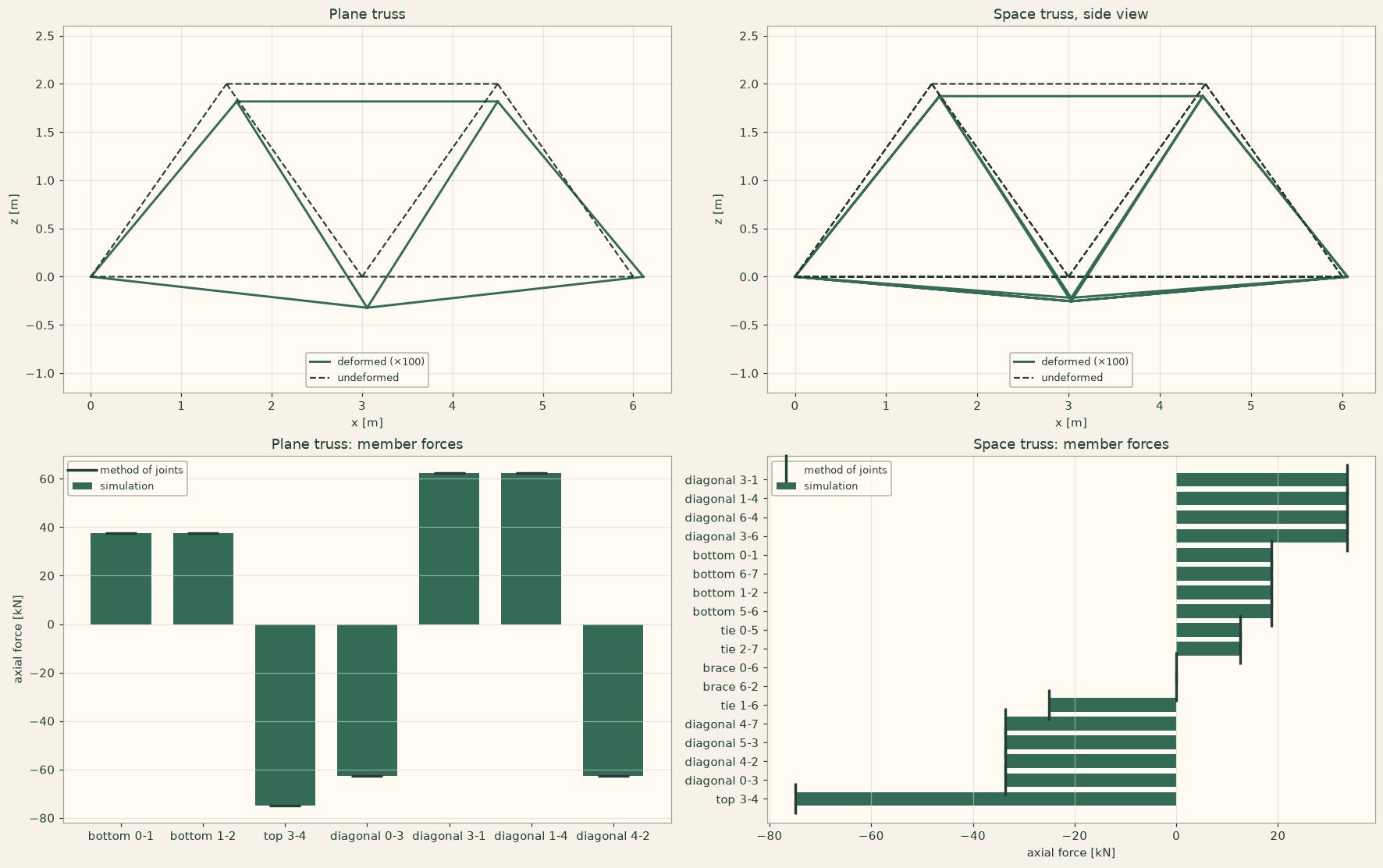
All 7 member forces of the plane truss and all 18 of the space truss agree with the method of joints to machine precision, and the deflection under the load matches the unit-load method (3.2188 mm and 2.3685 mm, deviation below 1e-13 %).
The notebook
The complete notebook, cell by cell. Run it to produce the figures and the comparison printout.
A truss is a framework of straight bars joined by pins. Its members carry only axial forces, no bending and no torsion, so each bar is one element with two nodes and three displacements per joint. This notebook first solves a plane truss: a 6 m span with two top joints, simply supported and loaded by \(F=100\) kN at the middle of the bottom chord. The same truss is then built as a space truss: two inclined side trusses share the top chord, three ties and two braces join the two bottom chords, and the load is split between the two loaded bottom joints.
| quantity | value |
|---|---|
| panel length \(a\), truss height \(h\) | 3 m, 2 m |
| half width of the space truss \(b\) | 1 m |
| steel bars | \(E=200\) GPa, \(A=10\) cm² |
| load | \(F=100\) kN at mid-span |
| joint (plane truss) | x [m] | z [m] | support |
|---|---|---|---|
| 0 | 0 | 0 | pin: \(u_x=u_z=0\) |
| 1 | 3 | 0 | load \(F\) |
| 2 | 6 | 0 | roller: \(u_z=0\) |
| 3 | 1.5 | 2 | |
| 4 | 4.5 | 2 |
In the space truss joints 0, 1, 2 lie at \(y=-b\), joints 5, 6, 7 at \(y=+b\), and the top joints 3 and 4 at \(y=0\); joints 1 and 6 carry \(F/2\) each.
Reference. The truss is statically determinate, so the method of joints gives every member force from equilibrium alone (Hibbeler, Structural Analysis, ch. 3). With the diagonal angle \(\tan\theta=2h/a\):
Each side of the space truss is the same plane truss, inclined by \(\tan\beta=b/h\) and of height \(h'=\sqrt{h^2+b^2}\); it carries the in-plane load \(F'=F/(2\cos\beta)\), the shared top chord collects both sides, and the ties take the horizontal components \(\mp\tfrac F2\tan\beta\) at the loaded joints and \(\tfrac F4\tan\beta\) at the supports; the braces of the bottom plane stay free of force under this symmetric load. The unit-load method (virtual work) gives the deflection under the load from the member forces, \(\delta=\sum_i N_i^2L_i/(EAF)\); in the space truss it is the mean of the two loaded joints.
import numpy as np
from onesim.physics.solid_mechanics import FrameMember, SpatialFrame
from onesim.visualization import plots, theme

theme.set()
Truss layouts
The joints are given as a table of coordinates; every member names its two end joints. Each bar is a FrameMember with only \(E\) and \(A\), which makes it an axial truss element; SpatialFrame joins the bars at shared joints.
a, h, b, force, youngs_modulus, area = 3.0, 2.0, 1.0, 100e3, 200e9, 10e-4
plane_joints = np.array(
    [[0, 0, 0], [a, 0, 0], [2 * a, 0, 0], [a / 2, 0, h], [1.5 * a, 0, h]]
)
plane_bars = {
    "bottom 0-1": (0, 1),
    "bottom 1-2": (1, 2),
    "top 3-4": (3, 4),
    "diagonal 0-3": (0, 3),
    "diagonal 3-1": (3, 1),
    "diagonal 1-4": (1, 4),
    "diagonal 4-2": (4, 2),
}
space_joints = np.array(
    [
        [0, -b, 0],
        [a, -b, 0],
        [2 * a, -b, 0],
        [a / 2, 0, h],
        [1.5 * a, 0, h],
        [0, b, 0],
        [a, b, 0],
        [2 * a, b, 0],
    ]
)
space_bars = {
    "bottom 0-1": (0, 1),
    "bottom 1-2": (1, 2),
    "bottom 5-6": (5, 6),
    "bottom 6-7": (6, 7),
    "top 3-4": (3, 4),
    "diagonal 0-3": (0, 3),
    "diagonal 3-1": (3, 1),
    "diagonal 1-4": (1, 4),
    "diagonal 4-2": (4, 2),
    "diagonal 5-3": (5, 3),
    "diagonal 3-6": (3, 6),
    "diagonal 6-4": (6, 4),
    "diagonal 4-7": (4, 7),
    "tie 0-5": (0, 5),
    "tie 1-6": (1, 6),
    "tie 2-7": (2, 7),
    "brace 0-6": (0, 6),
    "brace 6-2": (6, 2),
}
plane = SpatialFrame(
    joints=plane_joints,
    members=tuple(
        FrameMember(name=name, start=s, end=e, youngs_modulus=youngs_modulus, area=area)
        for name, (s, e) in plane_bars.items()
    ),
)
space = SpatialFrame(
    joints=space_joints,
    members=tuple(
        FrameMember(name=name, start=s, end=e, youngs_modulus=youngs_modulus, area=area)
        for name, (s, e) in space_bars.items()
    ),
)

drawing = {
    name: np.concatenate(
        (joints[np.array(list(bars.values()))], np.full((len(bars), 1, 3), np.nan)),
        axis=1,
    ).reshape(-1, 3)
    for name, joints, bars in (
        ("plane", plane_joints, plane_bars),
        ("space", space_joints, space_bars),
    )
}
fig = plots.figure(1, 3, size=(17, 4.5))
plots.line(
    None,
    {"bars": (drawing["plane"][:, 0], drawing["plane"][:, 2])},
    points={"joints": (plane_joints[:, 0], plane_joints[:, 2])},
    legend=False,
    xlabel="x [m]",
    ylabel="z [m]",
    ylimits=(-0.5, 2.5),
    title="Plane truss, 7 bars",
    ax=fig[0],
)
plots.line(
    None,
    {"bars": (drawing["space"][:, 0], drawing["space"][:, 1])},
    points={"joints": (space_joints[:, 0], space_joints[:, 1])},
    legend=False,
    xlabel="x [m]",
    ylabel="y [m]",
    ylimits=(-1.5, 1.5),
    title="Space truss, plan view, 18 bars",
    ax=fig[1],
)
plots.line(
    None,
    {"bars": (drawing["space"][:, 1], drawing["space"][:, 2])},
    points={"joints": (space_joints[:, 1], space_joints[:, 2])},
    legend=False,
    xlabel="y [m]",
    ylabel="z [m]",
    xlimits=(-2, 2),
    ylimits=(-0.5, 2.5),
    title="Space truss, end view",
    ax=fig[2],
)
plots.show()
Model
The plane truss is held at \(u_y=0\) in every joint, which keeps it in its plane. The space truss rests on its four corner joints: joint 0 is fixed, joint 2 slides in \(x\), and joints 5 and 7 slide in both horizontal directions.
plane_result = plane.solve(
    supports=[(0, "x", 0), (0, "z", 0), (2, "z", 0)]
    + [(joint, "y", 0) for joint in range(5)],
    forces={1: (0, 0, -force)},
)
space_result = space.solve(
    supports=[
        (0, "x", 0),
        (0, "y", 0),
        (0, "z", 0),
        (2, "y", 0),
        (2, "z", 0),
        (5, "z", 0),
        (7, "z", 0),
    ],
    forces={1: (0, 0, -force / 2), 6: (0, 0, -force / 2)},
)
axial = {
    name: {bar: result.members[bar].local_end_actions[1] for bar in bars}
    for name, result, bars in (
        ("plane", plane_result, plane_bars),
        ("space", space_result, space_bars),
    )
}
Results
Member forces of both trusses against the method of joints (tension positive) and the deflection under the load against the unit-load method.
theta, tilt = np.arctan(2 * h / a), np.arctan(b / h)
side_load, side_theta = force / (2 * np.cos(tilt)), np.arctan(2 * np.hypot(h, b) / a)
joints_method = lambda load, angle: {
    "bottom": load / (2 * np.tan(angle)),
    "top": -load / np.tan(angle),
    "diagonal": load / (2 * np.sin(angle)),
}
plane_reference = joints_method(force, theta)
side_reference = joints_method(side_load, side_theta)
reference = {
    "plane": {
        bar: plane_reference[bar.split()[0]]
        * (-1 if bar in ("diagonal 0-3", "diagonal 4-2") else 1)
        for bar in plane_bars
    },
    "space": {
        **{
            bar: side_reference[bar.split()[0]]
            * (-1 if bar[-3:] in ("0-3", "4-2", "5-3", "4-7") else 1)
            for bar in space_bars
            if bar.split()[0] in side_reference
        },
        "top 3-4": 2 * side_reference["top"],
        "tie 0-5": force / 4 * np.tan(tilt),
        "tie 1-6": -force / 2 * np.tan(tilt),
        "tie 2-7": force / 4 * np.tan(tilt),
        "brace 0-6": 0.0,
        "brace 6-2": 0.0,
    },
}
lengths = {
    name: {bar: np.linalg.norm(joints[e] - joints[s]) for bar, (s, e) in bars.items()}
    for name, joints, bars in (
        ("plane", plane_joints, plane_bars),
        ("space", space_joints, space_bars),
    )
}
unit_load = {
    name: sum(reference[name][bar] ** 2 * lengths[name][bar] for bar in reference[name])
    / (youngs_modulus * area * force)
    for name in reference
}

for name in ("plane", "space"):
    print(f"{name} truss          simulation [kN]   method of joints [kN]")
    for bar in axial[name]:
        print(
            f"  {bar:16s} {axial[name][bar] / 1e3:14.3f} {reference[name][bar] / 1e3:20.3f}"
        )
deflections = {
    "plane": -plane_result.displacement[1, 2],
    "space": -space_result.displacement[[1, 6], 2].mean(),
}
for name, value in deflections.items():
    print(
        f"{name} truss deflection under the load: simulation {1e3 * value:.4f} mm, unit-load method "
        f"{1e3 * unit_load[name]:.4f} mm, deviation {100 * (value / unit_load[name] - 1):+.1e} %"
    )
print(
    f"vertical reactions of the space truss: {space_result.reaction_force[[0, 2, 5, 7], 2] / 1e3} kN"
)
Figure
The deformed trusses (displacements magnified 100 times) and the member forces against the method of joints. The diagonals running down towards the load are in tension, the outer diagonals and the top chord in compression.
scale = 100
deformed = {
    name: np.concatenate(
        (
            (joints + scale * result.displacement)[np.array(list(bars.values()))],
            np.full((len(bars), 1, 3), np.nan),
        ),
        axis=1,
    ).reshape(-1, 3)
    for name, joints, bars, result in (
        ("plane", plane_joints, plane_bars, plane_result),
        ("space", space_joints, space_bars, space_result),
    )
}
fig = plots.figure(2, 2, size=(16, 10))
plots.line(
    None,
    {"deformed (×100)": (deformed["plane"][:, 0], deformed["plane"][:, 2])},
    reference={"undeformed": (drawing["plane"][:, 0], drawing["plane"][:, 2])},
    ylimits=(-1.2, 2.6),
    legend="lower center",
    xlabel="x [m]",
    ylabel="z [m]",
    title="Plane truss",
    ax=fig[0],
)
plots.line(
    None,
    {"deformed (×100)": (deformed["space"][:, 0], deformed["space"][:, 2])},
    reference={"undeformed": (drawing["space"][:, 0], drawing["space"][:, 2])},
    ylimits=(-1.2, 2.6),
    legend="lower center",
    xlabel="x [m]",
    ylabel="z [m]",
    title="Space truss, side view",
    ax=fig[1],
)
plots.bars(
    list(plane_bars),
    {"simulation": [axial["plane"][bar] / 1e3 for bar in plane_bars]},
    reference={
        "method of joints": [reference["plane"][bar] / 1e3 for bar in plane_bars]
    },
    ylabel="axial force [kN]",
    title="Plane truss: member forces",
    ax=fig[2],
)
ranked = sorted(space_bars, key=axial["space"].get)
plots.bars(
    ranked,
    {"simulation": [axial["space"][bar] / 1e3 for bar in ranked]},
    reference={"method of joints": [reference["space"][bar] / 1e3 for bar in ranked]},
    horizontal=True,
    ylabel="axial force [kN]",
    title="Space truss: member forces",
    ax=fig[3],
)
plots.show()
Going further
Change the joint table, for example a higher truss or more panels, and the solver follows; a statically indeterminate truss (an extra diagonal) needs no change at all, while the method of joints no longer suffices. Give the members their bending stiffness (bending_inertia_y, ...) and the same frame becomes a rigid-jointed frame with secondary moments.