To reproduce the case, put its notebook and accompanying inputs in the same folder. Use the Python environment set up in the installation tutorial. Start with the original parameters and compare the result with the check reported below.
Run this example yourself. The OneSimulation Runtime brings the full Python library and an MCP server for Codex and Claude Code. It starts with a seven-day trial, then from €19 per month before any applicable tax.
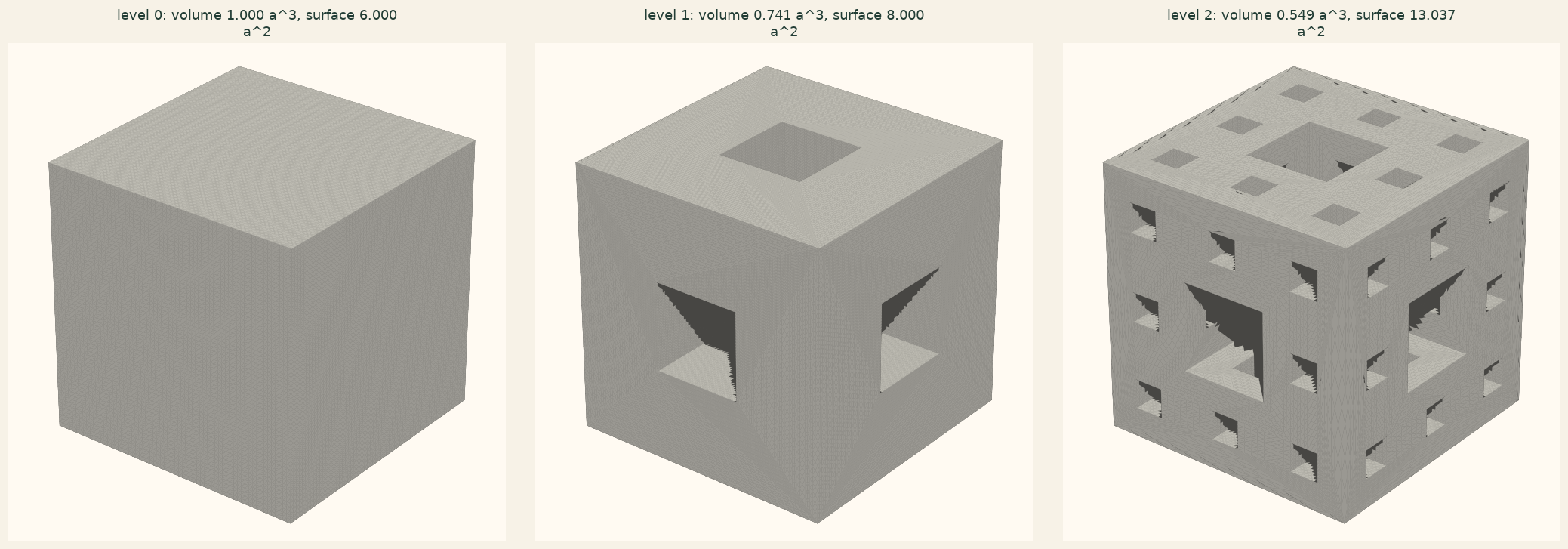
What it computes
OneSimulation builds the bars of each level of the recursion as a list of boxes and subtracts them from the cube one after another; each level is meshed with tetrahedra.
What it checks
Volume and surface area of every level equal the series a^3 (20/27)^n and 2a^2 (20/9)^n + 4a^2 (8/9)^n exactly (400.0000 cm3 and 1056.0000 cm2 at level 2), the mesh of 56,466 tetrahedra has the same volume, and the centre of mass stays at the centre of the cube to the micrometre.
The notebook
The complete notebook, cell by cell. Run it to produce the figures and the comparison printout.
A geometry that repeats itself at smaller and smaller scales is easiest to describe by a rule and a loop. The Menger sponge of level \(n\) is a cube of side \(a\) from which, at every level \(k=1,\dots,n\), all points are removed whose \(k\)-th ternary digit is 1 in at least two of the three coordinates. Removing exactly those points is the same as cutting square bars of width \(a/3^k\) through the whole cube along each axis, at the positions where both cross coordinates have the digit 1 at that level: \(3\cdot 9^{k-1}\) bars at level \(k\).
Each level keeps 20 of the 27 sub-cubes, so volume and surface follow geometric series:
and the centre of mass stays in the centre of the cube. The volume tends to zero and the surface to infinity: the limit has the fractal dimension \(\ln 20/\ln 3 \approx 2.73\).
Reference. K. Menger, Allgemeine Räume und Cartesische Räume, Proc. Royal Academy Amsterdam 29 (1926) 476-482; volume and surface series as in B. Mandelbrot, The Fractal Geometry of Nature, Freeman 1982, ch. 14.
from functools import reduce

import numpy as np
from onesim.cad.d3 import Box
from onesim.meshing import TetrahedralMesher
from onesim.meshing.quality import quality
from onesim.visualization import plots, theme

theme.set()
The recursion
For every level the bars are a list comprehension over the grid of \(3^k\times3^k\) positions; the sponge of a level is the cube with all bars of all levels up to it subtracted one after another (reduce over the list with body - bar).
side = 0.09
cube = Box(length=side, width=side, height=side)
bars = {
    level: [
        bar
        for i in range(3**level)
        for j in range(3**level)
        if i % 3 == 1 and j % 3 == 1
        for w in [side / 3**level]
        for bar in (
            Box(length=w, width=w, height=side, origin=(i * w, j * w, 0.0)),
            Box(length=side, width=w, height=w, origin=(0.0, i * w, j * w)),
            Box(length=w, width=side, height=w, origin=(i * w, 0.0, j * w)),
        )
    ]
    for level in (1, 2)
}
sponges = [cube]
for level in (1, 2):
    sponges.append(reduce(lambda body, bar: body - bar, bars[level], sponges[-1]))
print(", ".join(f"level {level}: {len(items)} bars" for level, items in bars.items()))

meshes = [
    TetrahedralMesher(target_size=side / 9).generate(sponges[0]),
    TetrahedralMesher(target_size=side / 15).generate(sponges[1]),
    TetrahedralMesher(target_size=side / 27).generate(sponges[2]),
]

view = plots.Camera(elevation=28, azimuth=-52)
fig = plots.figure(1, 2, size=(16, 7))
plots.render(
    sponges[2],
    camera=view,
    material="ceramic",
    title="Menger sponge of level 2",
    ax=fig[0],
)
plots.mesh(
    meshes[2],
    cell_values=quality(meshes[2])["shape"],
    limits=(0, 1),
    plane=((side / 2, side / 2, side / 2), (0.0, 1.0, 0.0)),
    label="shape measure",
    camera=view,
    title=f"Level 2: {meshes[2].cell_count} tetrahedra, cut at the mid-plane",
    ax=fig[1],
)
plots.show()
Results
Volume and surface area of the CAD body and of the mesh, and the centre of mass, against the closed-form series.
volume = lambda n: side**3 * (20 / 27) ** n
surface = lambda n: 2 * side**2 * (20 / 9) ** n + 4 * side**2 * (8 / 9) ** n
print(
    "level  faces   volume CAD [cm3]  mesh     closed form   surface CAD [cm2]  closed form   cells"
)
for level, (sponge, mesh) in enumerate(zip(sponges, meshes)):
    print(
        f"{level:5d} {len(sponge.faces):6d} {sponge.measure * 1e6:14.4f} {quality(mesh)['size'].sum() * 1e6:10.4f} {volume(level) * 1e6:12.4f}"
        f" {sponge.surface_area * 1e4:17.4f} {surface(level) * 1e4:12.4f} {mesh.cell_count:9d}"
    )
centre = sponges[2].center_of_mass
print(
    f"centre of mass of level 2: ({1e3 * centre[0]:.6f}, {1e3 * centre[1]:.6f}, {1e3 * centre[2]:.6f}) mm, "
    f"centre of the cube ({1e3 * side / 2:.6f}, {1e3 * side / 2:.6f}, {1e3 * side / 2:.6f}) mm"
)
print(
    f"volume fraction left at level 2: {sponges[2].measure / side**3:.6f} (20/27)^2 = {(20 / 27)**2:.6f}"
)
Figure
The three levels side by side, rendered as shaded solids, with their volume and surface.
fig = plots.figure(1, 3, size=(19, 6.5))
for level in range(3):
    plots.render(
        sponges[level],
        camera=view,
        material="ceramic",
        title=f"level {level}: volume {sponges[level].measure / side**3:.3f} a^3, surface {sponges[level].surface_area / side**2:.3f} a^2",
        ax=fig[level],
    )
plots.show()
Going further
Extend the dictionary of bars to level 3 (273 bars; the CAD body takes a few minutes), build the Sierpinski tetrahedron from Cone(..., top_radius=0) pyramids the same way, or solve a heat conduction problem on the sponge to see how the effective conductivity falls with the level.