To reproduce the case, put its notebook and accompanying inputs in the same folder. Use the Python environment set up in the installation tutorial. Start with the original parameters and compare the result with the check reported below.
Run this example yourself. The OneSimulation Runtime brings the full Python library and an MCP server for Codex and Claude Code. It starts with a seven-day trial, then from €19 per month before any applicable tax.
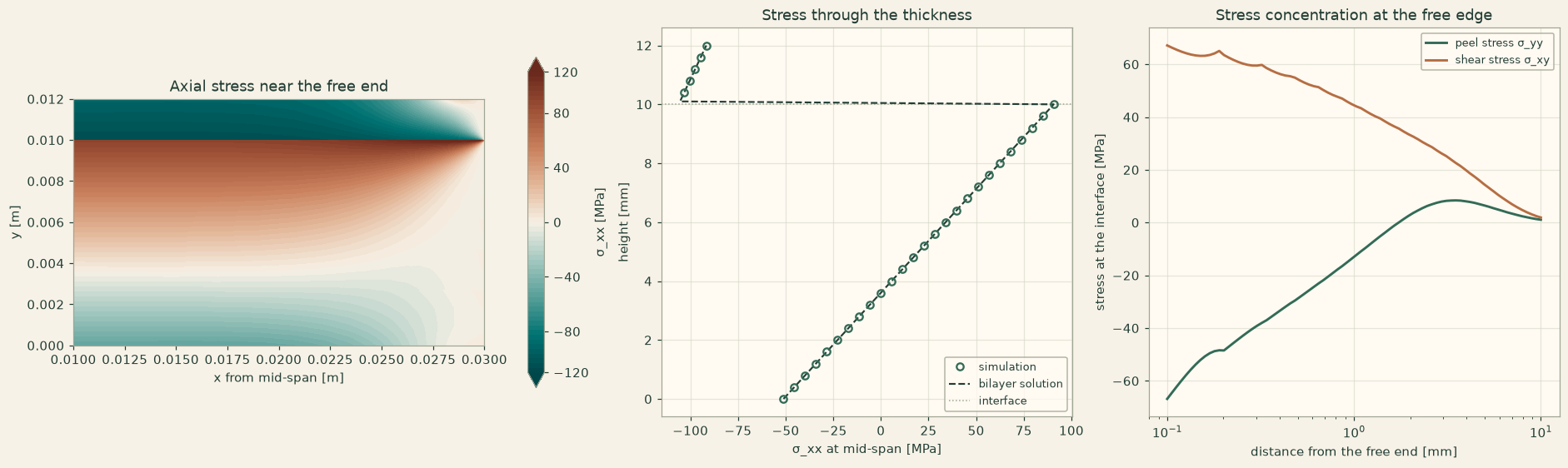
What it computes
OneSimulation cuts the plate from the STEP file to its cross-section and solves 2D plane-strain thermoelasticity with quadratic quadrilaterals graded towards the interface and the free end; each layer is its own region with its own material, and the cooled temperature comes from a heat-conduction solve on the same section. The script that builds the STEP file comes with the notebook.
What it checks
At mid-span the axial stress matches the closed-form bilayer solution at the faces and on both sides of the interface to 0.01 MPa (-51.11, 90.68, -106.14 and -91.67 MPa); towards the free edge peel and shear stress rise to about 65 MPa at the interface.
Geometry
The notebook starts at the import of the CAD files layered_plate_thermal_stress.step, layered_plate_thermal_stress_coating.step: STEP (AP242), readable by any CAD program, with the names of the faces that the boundary conditions use. Put them next to the notebook.
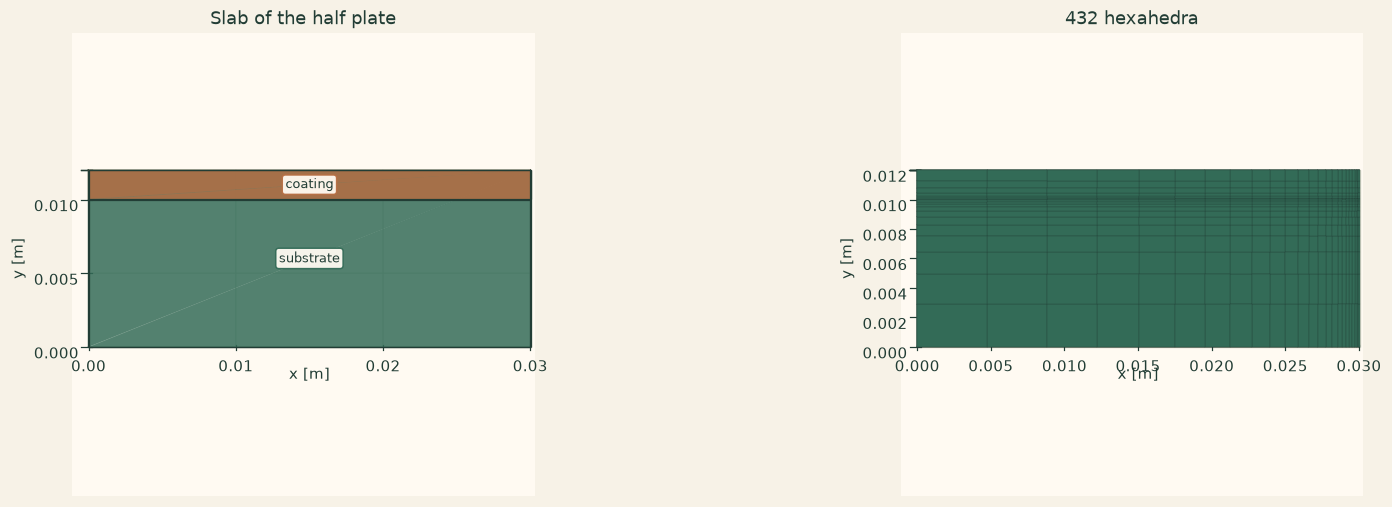
The geometry script
The script layered_plate_thermal_stress_geometry.py builds the geometry with the CAD objects of OneSimulation and writes the files. Change a dimension there, run it, and run the notebook again.
"""Geometry of the OneSimulation example "Thermal stresses in a coated plate".

Builds a thin slab of one half of the plate (30 mm long, 10 mm substrate with a 2 mm coating,
0.5 mm deep) with the CAD objects of OneSimulation and writes layered_plate_thermal_stress.step;
its faces keep the names x_min, x_max, y_min, y_max, z_min and z_max. The coating, which marks the
region of the second material, is written to layered_plate_thermal_stress_coating.step. The
example computes on the cross-section z = 0.25 mm in plane strain.
"""

from onesim.cad.d3 import Box

half_length, substrate, coating, slab = 0.030, 0.010, 0.002, 0.0005
plate = Box(length=half_length, width=substrate + coating, height=slab)
coat = Box(length=half_length, width=coating, height=slab, origin=(0.0, substrate, 0.0))
plate.save("layered_plate_thermal_stress.step")
coat.save("layered_plate_thermal_stress_coating.step")
The notebook
The complete notebook, cell by cell. Run it to produce the figures and the comparison printout.
A substrate plate (10 mm thick) carries a coating (2 mm thick). The coating is deposited at 800 °C, where both layers are stress free, and the plate is then cooled to 150 °C. The substrate contracts more than the coating, so the coating ends up in compression and the plate bends. Near the free ends the stresses must turn around, which concentrates peel and shear stress at the interface.
| layer | \(E\) | \(\nu\) | \(\alpha\) |
|---|---|---|---|
| substrate | 130 GPa | 0.28 | \(3\cdot10^{-6}\) 1/K |
| coating | 70 GPa | 0.17 | \(5\cdot10^{-7}\) 1/K |
The plate is long in the third direction and is in plane strain, \(u_z=0\).
A thin slab of one half of the 60 mm long plate comes from the CAD file layered_plate_thermal_stress.step; layered_plate_thermal_stress_coating.step holds the coating, which marks the region of the second material. The script layered_plate_thermal_stress_geometry.py builds both with the CAD objects of OneSimulation. The model is two-dimensional: it lives on the cross-section of the slab, with one region and one material per layer.
Reference. Away from the ends the plate behaves like a bilayer beam (Timoshenko, 1925). With \(E_i'=E_i/(1-\nu_i^2)\) and the thermal strain \(e_i=(1+\nu_i)\alpha_i\Delta T\),
where the two balances fix the strain \(\varepsilon_0\) and the curvature \(\kappa\).
import numpy as np
from onesim.cad.exchange import load
from onesim.materials import IsotropicSolid, regionwise
from onesim.meshing import Geometric, cartesian
from onesim.numerics import Numerics
from onesim.numerics.fem import FiniteElement, Lagrange
from onesim.numerics.field_transfer import FiniteElementEvaluation
from onesim.numerics.linear import SparseDirect
from onesim.physics.heat_transfer import FixedTemperature, HeatConduction
from onesim.physics.solid_mechanics import (
    FixedDisplacementComponents,
    IsotropicThermalExpansion,
    LinearElasticity,
    TractionFree,
)
from onesim.simulation import Problem, Simulation
from onesim.simulation.field_connections import FieldCoupling
from onesim.visualization import plots, theme

theme.set()
Geometry and mesh
load returns the slab and the coating, section cuts both at half depth; the regions keep the side names x_min (mid-span), x_max (free end), y_min and y_max. The quadrilateral mesh has a node line on the interface and is graded towards it and towards the free end.
plate, coat = load("layered_plate_thermal_stress.step"), load(
    "layered_plate_thermal_stress_coating.step"
)
half_length, thickness, slab = plate.size
coating = coat.size[1]
substrate = thickness - coating
section = plate.section((0, 0, 1), origin=(0, 0, slab / 2))
coating_region = coat.section((0, 0, 1), origin=(0, 0, slab / 2))
sides = section.boundaries
along = half_length * Geometric(25, ratio=50.0, toward="end").reference()
across = np.r_[
    substrate * Geometric(13, ratio=40.0, toward="end").reference(),
    substrate + coating * Geometric(7, ratio=8.0).reference()[1:],
]
mesh = cartesian(
    geometry=section,
    shape=(along.size - 1, across.size - 1),
    extents=(half_length, thickness),
    node_axes=(tuple(along), tuple(across)),
).build()

fig = plots.figure(1, 2, size=(15, 5))
plots.geometry(
    [plate.named("substrate"), coat.named("coating")],
    camera=plots.Camera(elevation=35, azimuth=-60),
    title="Slab of the half plate",
    ax=fig[0],
)
plots.geometry(
    section,
    title=f"Cross-section with its named sides, meshed with {mesh.cell_count} quadrilaterals",
    ax=fig[1],
)
plots.show()
Model
Plane strain on the cross-section. The mid-span \(x=0\) is a symmetry line, held vertically at its lower end. The material properties are given region by region. The uniform final temperature comes from a heat-conduction model on the same section and enters the mechanics as thermal strain.
layers = {"substrate": (130e9, 0.28, 3.0e-6), "coating": (70e9, 0.17, 5.0e-7)}
deposition, final = 1073.15, 423.15
layered = lambda index, unit: regionwise(
    ((coating_region, layers["coating"][index]),),
    default=layers["substrate"][index],
    unit=unit,
)
material = IsotropicSolid(
    density=3000.0,
    specific_heat_capacity=700.0,
    thermal_conductivity=30.0,
    youngs_modulus=layered(0, "Pa"),
    poisson_ratio=layered(1, "1"),
    thermal_expansion_coefficient=layered(2, "1/K"),
)
numerics = Numerics(
    spatial=FiniteElement(element=Lagrange(order=2)), linear_solver=SparseDirect()
)

heat = HeatConduction(domain=section.domain(), material=material)
cooled = Simulation(
    problem=Problem(
        name="Final temperature",
        geometry=section,
        physics=(heat,),
        boundary_conditions=(
            FixedTemperature(boundary=sides.all, physics=heat, value=final),
        ),
    ),
    mesh=mesh,
    numerics=numerics,
).solve_stationary()

solid = LinearElasticity(
    domain=section.domain(),
    material=material,
    kinematics="plane_strain",
    thermal_strain=IsotropicThermalExpansion(reference_temperature=deposition),
)
problem = Problem(
    name="Coated plate",
    geometry=section,
    physics=(solid,),
    boundary_conditions=(
        TractionFree(boundary=sides.x_max | sides.y_min | sides.y_max, physics=solid),
        FixedDisplacementComponents(
            boundary=sides.x_min,
            physics=solid,
            components=("x", "y"),
            where={"y": lambda x, y: y < 1e-9},
        ),
    ),
    couplings=(
        FieldCoupling(
            source=cooled.field(heat.temperature),
            target=solid.temperature,
            transfer=FiniteElementEvaluation(),
        ),
    ),
)
stress = (
    Simulation(problem=problem, mesh=mesh, numerics=numerics)
    .solve_stationary()
    .field(solid.stress)
)
Results
The axial stress at mid-span against the bilayer solution of Timoshenko.
def bilayer_stress(y):
    """Axial stress of the bilayer beam at the height y."""
    stiffness, load_vector = np.zeros((2, 2)), np.zeros(2)
    for (E, nu, alpha), (lower, upper) in zip(
        layers.values(), ((0, substrate), (substrate, substrate + coating))
    ):
        moments = [(upper**k - lower**k) / k for k in (1, 2, 3)]
        stiffness += E / (1 - nu**2) * np.array([moments[:2], moments[1:]])
        load_vector += (
            E
            / (1 - nu**2)
            * (1 + nu)
            * alpha
            * (final - deposition)
            * np.array(moments[:2])
        )
    strain, curvature = np.linalg.solve(stiffness, load_vector)
    E, nu, alpha = (
        np.where(np.asarray(y) > substrate, c, s) for s, c in zip(*layers.values())
    )
    return (
        E
        / (1 - nu**2)
        * (strain + curvature * np.asarray(y) - (1 + nu) * alpha * (final - deposition))
    )


heights = {
    "lower face": 2e-6,
    "substrate at the interface": substrate - 2e-6,
    "coating at the interface": substrate + 2e-6,
    "upper face": substrate + coating - 2e-6,
}
at_mid_span = stress.evaluate([[1e-6, y] for y in heights.values()])[:, 0]
print(f"{'position':28s} simulation [MPa]   bilayer [MPa]")
for (label, y), value in zip(heights.items(), at_mid_span):
    print(f"{label:28s} {value / 1e6:16.2f} {bilayer_stress(y) / 1e6:15.2f}")
Figure
The axial stress near one end of the plate, the stress through the thickness at mid-span, and the peel and shear stress along the interface towards the free end.
megapascal = lambda s, position: s[:, 0] / 1e6
y = np.linspace(1e-6, substrate + coating - 1e-6, 121)
through = stress.evaluate(np.column_stack((np.full_like(y, 1e-6), y)))[:, 0]
distance = np.geomspace(1e-4, 0.01, 80)
interface = stress.evaluate(
    np.column_stack((half_length - distance, np.full_like(distance, substrate - 2e-6)))
)

fig = plots.figure(1, 3, size=(17, 5))
plots.surface(
    stress,
    component=megapascal,
    colormap="diverging",
    limits=(-110, 110),
    subdivisions=3,
    label="σ_xx [MPa]",
    title="Axial stress near the free end",
    xlimits=(0.01, 0.03),
    xlabel="x from mid-span [m]",
    ylabel="y [m]",
    ax=fig[0],
)
plots.line(
    points={"simulation": (through[::4] / 1e6, 1e3 * y[::4])},
    reference={"bilayer solution": (bilayer_stress(y) / 1e6, 1e3 * y)},
    hlines={"interface": 1e3 * substrate},
    xlabel="σ_xx at mid-span [MPa]",
    ylabel="height [mm]",
    title="Stress through the thickness",
    legend="lower right",
    ax=fig[1],
)
plots.line(
    1e3 * distance,
    {
        "peel stress σ_yy": interface[:, 1] / 1e6,
        "shear stress σ_xy": interface[:, 3] / 1e6,
    },
    scale="logx",
    xlabel="distance from the free end [mm]",
    ylabel="stress at the interface [MPa]",
    title="Stress concentration at the free edge",
    ax=fig[2],
)
plots.show()
Going further
Make the coating thinner in layered_plate_thermal_stress_geometry.py, write the files again, and the stress in it approaches the film limit \(E_c'(1+\nu)\,\Delta\alpha\,\Delta T\); add a compliant interlayer and watch the edge stresses drop.