To reproduce the case, put its notebook and accompanying inputs in the same folder. Use the Python environment set up in the installation tutorial. Start with the original parameters and compare the result with the check reported below.
Run this example yourself. The OneSimulation Runtime brings the full Python library and an MCP server for Codex and Claude Code. It starts with a seven-day trial, then from €19 per month before any applicable tax.
What it computes
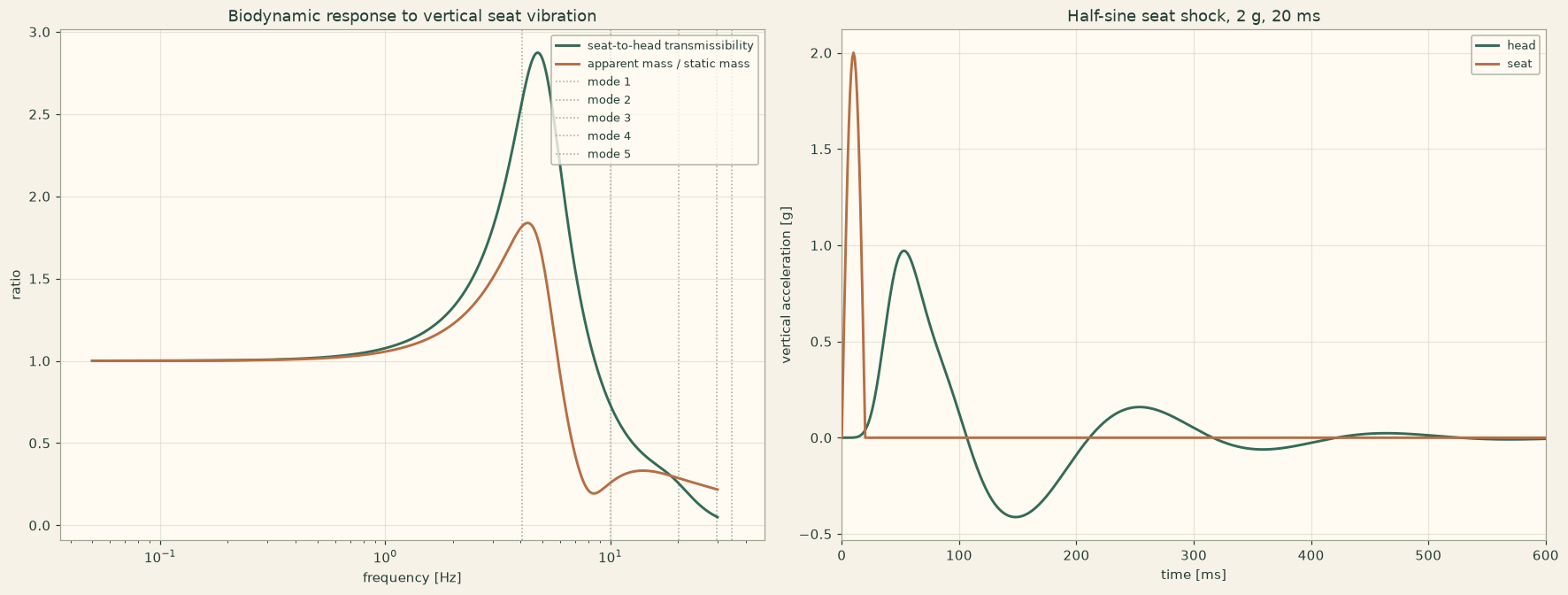
OneSimulation assembles the network, solves the natural modes, the seat-to-head transmissibility and the apparent mass over 0.05-30 Hz, and the transient response to a half-sine seat shock.
What it checks
At 0.05 Hz the transmissibility is 1.0002 and the apparent mass 76.81 kg against the total mass 76.8 kg; the whole-body resonance lies at 4.3 Hz (apparent mass 1.84 times static); input and dissipated power agree in every harmonic state, and after the shock all segments move with the seat's velocity change 0.2498 m/s.
The notebook
The complete notebook, cell by cell. Run it to produce the figures and the comparison printout.
How a seated person responds to vertical vibration of the seat, in a vehicle, a helicopter or on a construction machine, is described by biodynamic models: the body segments are masses, the tissues between them springs and dampers. Two measures characterise such a model. The seat-to-head transmissibility \(T(f)=a_\text{head}/a_\text{seat}\) tells how much of the seat motion arrives at the head; the apparent mass \(M(f)=F_\text{seat}/a_\text{seat}\) is the dynamic mass the seat feels. Both show the well-known whole-body resonance near 4-6 Hz (Griffin, Handbook of Human Vibration, Academic Press 1990).
Setup. A chain from the seat upwards (masses in kg, stiffness in kN/m, damping in N s/m):
| segment | mass | connection below | stiffness | damping |
|---|---|---|---|---|
| pelvis | 36.0 | seat | 75 | 3500 |
| abdomen | 5.5 | pelvis | 100 | 330 |
| thorax | 15.0 | abdomen | 120 | 800 |
| upper torso | 15.0 | thorax | 150 | 900 |
| head and neck | 5.3 | upper torso | 120 | 400 |
The seat moves vertically, harmonically or as a half-sine shock of 2 g and 20 ms.
Reference. (1) For \(f\to0\) the body moves rigidly with the seat: \(T\to1\) and \(M\to\sum m_i\) (Newton's second law for the whole body). (2) In every harmonic state the mean power the seat puts into the body equals the power dissipated in the dampers. (3) A shock of velocity change \(\Delta v\) leaves every segment, once the vibration has decayed, moving with the seat.
import numpy as np
from onesim.physics.solid_mechanics import Damper, LumpedMechanicalNetwork, Spring
from onesim.visualization import plots, theme

theme.set()
Model
Five coordinates and one input, the seat height; each element connects a segment to the one below.
segments = {
    "pelvis": 36.0,
    "abdomen": 5.5,
    "thorax": 15.0,
    "upper torso": 15.0,
    "head": 5.3,
}
below = {
    "pelvis": "seat",
    "abdomen": "pelvis",
    "thorax": "abdomen",
    "upper torso": "thorax",
    "head": "upper torso",
}
stiffness = {
    "pelvis": 75e3,
    "abdomen": 100e3,
    "thorax": 120e3,
    "upper torso": 150e3,
    "head": 120e3,
}
damping = {
    "pelvis": 3500.0,
    "abdomen": 330.0,
    "thorax": 800.0,
    "upper torso": 900.0,
    "head": 400.0,
}
body = LumpedMechanicalNetwork(
    inertias=segments,
    springs=tuple(Spring(stiffness[name], name, below[name]) for name in segments),
    dampers=tuple(Damper(damping[name], name, below[name]) for name in segments),
    inputs=("seat",),
)
Natural modes, transmissibility and apparent mass
The response to a unit seat displacement gives both measures: \(T=X_\text{head}\), and the seat force is the sum of the segment inertia forces, \(F=-\omega^2\sum m_iX_i\), so \(M=\sum m_iX_i\) for a unit seat acceleration \(-\omega^2\).
modes = body.modes()
for k, frequency in enumerate(modes.frequencies):
    shape = modes.shape(k)
    print(
        f"mode {k + 1}: {frequency:6.2f} Hz, largest motion in the {max(shape, key=lambda name: abs(shape[name]))}"
    )
frequencies = np.geomspace(0.05, 30.0, 500)
response = body.frequency_response(frequencies, inputs={"seat": 1.0})
transmissibility = np.abs(response["head"])
apparent = np.abs(sum(mass * response[name] for name, mass in segments.items()))
peak = int(np.argmax(apparent))
print(
    f"at 0.05 Hz: transmissibility {transmissibility[0]:.5f} (rigid: 1), apparent mass {apparent[0]:.3f} kg (total mass {sum(segments.values()):.1f} kg)"
)
print(
    f"apparent mass peaks at {frequencies[peak]:.2f} Hz with {apparent[peak] / sum(segments.values()):.2f} times the static mass; "
    f"transmissibility peaks at {frequencies[np.argmax(transmissibility)]:.2f} Hz with {transmissibility.max():.2f}"
)
for f in (2.0, 5.0, 12.0):
    state = body.frequency_response([f], inputs={"seat": 1e-3})
    omega = 2 * np.pi * f
    force = stiffness["pelvis"] * (1e-3 - state["pelvis"][0]) + damping[
        "pelvis"
    ] * 1j * omega * (1e-3 - state["pelvis"][0])
    supplied = 0.5 * np.real(np.conj(1j * omega * 1e-3) * force)
    print(
        f"{f:4.1f} Hz, 1 mm seat amplitude: power from the seat {supplied:.6f} W, dissipated {body.dissipated_power(f, {n: v[0] for n, v in state.items()}, inputs={'seat': 1e-3}):.6f} W"
    )
Seat shock
A half-sine acceleration pulse of 2 g and 20 ms; its velocity change is \(\Delta v=2\cdot 2g\cdot0.02/\pi\). The seat height is the twice-integrated pulse.
amplitude, duration = 2 * 9.81, 0.020
seat = lambda t: (
    amplitude
    * duration
    / np.pi
    * (
        np.clip(t, 0.0, duration)
        - duration / np.pi * np.sin(np.pi * np.clip(t, 0.0, duration) / duration)
    )
    + amplitude * duration * 2 / np.pi * max(t - duration, 0.0)
)
times = np.linspace(0.0, 1.5, 1501)
positions, velocities = body.transient(times, inputs={"seat": seat})
head_acceleration = np.gradient(velocities["head"], times)
jump = amplitude * duration * 2 / np.pi
print(
    f"seat shock: velocity change {jump:.4f} m/s; after 1.5 s the segments move at "
    + ", ".join(f"{name} {velocities[name][-1]:.4f}" for name in segments)
    + " m/s"
)
print(
    f"largest head acceleration {np.abs(head_acceleration).max() / 9.81:.2f} g against 2 g at the seat"
)
Figure
Left the seat-to-head transmissibility and the normalised apparent mass with the natural frequencies; right the head acceleration after the seat shock.
fig = plots.figure(1, 2, size=(16, 6))
plots.line(
    y={
        "seat-to-head transmissibility": (frequencies, transmissibility),
        "apparent mass / static mass": (frequencies, apparent / sum(segments.values())),
    },
    vlines={f"mode {k + 1}": f for k, f in enumerate(modes.frequencies)},
    scale="logx",
    xlabel="frequency [Hz]",
    ylabel="ratio",
    title="Biodynamic response to vertical seat vibration",
    legend="upper right",
    ax=fig[0],
)
plots.line(
    y={
        "head": (1e3 * times, head_acceleration / 9.81),
        "seat": (
            1e3 * times,
            np.where(times <= duration, 2 * np.sin(np.pi * times / duration), 0.0),
        ),
    },
    xlimits=(0, 600),
    xlabel="time [ms]",
    ylabel="vertical acceleration [g]",
    title="Half-sine seat shock, 2 g, 20 ms",
    legend="upper right",
    ax=fig[1],
)
plots.show()
Going further
Add a seat cushion between the seat pan and the pelvis and tune it to lower the transmissibility at 5 Hz, couple the model to the vehicle model of the companion example, or fit the stiffness and damping values to measured apparent-mass curves with a least-squares study.