To reproduce the case, put its notebook and accompanying inputs in the same folder. Use the Python environment set up in the installation tutorial. Start with the original parameters and compare the result with the check reported below.
Run this example yourself. The OneSimulation Runtime brings the full Python library and an MCP server for Codex and Claude Code. It starts with a seven-day trial, then from €19 per month before any applicable tax.
What it computes
OneSimulation cuts the quarter membrane from the STEP file to its mid-plane and solves plane stress with linear and quadratic triangles on three meshes; the outward pressure follows the normal of the outer ellipse and the hoop stress is evaluated exactly at the benchmark point. The script that builds the STEP file comes with the notebook.
What it checks
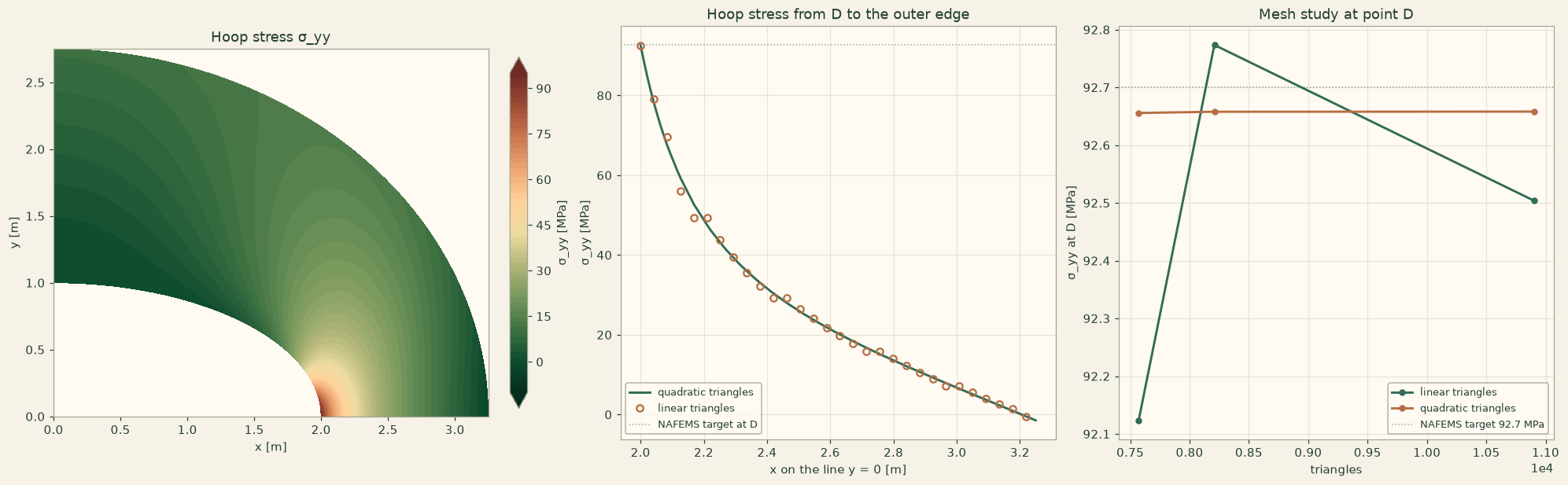
Quadratic triangles give 92.66 MPa at point D on all three meshes against the NAFEMS target of 92.7 MPa (-0.05 %); linear triangles scatter between -0.62 % and +0.08 %.
Geometry
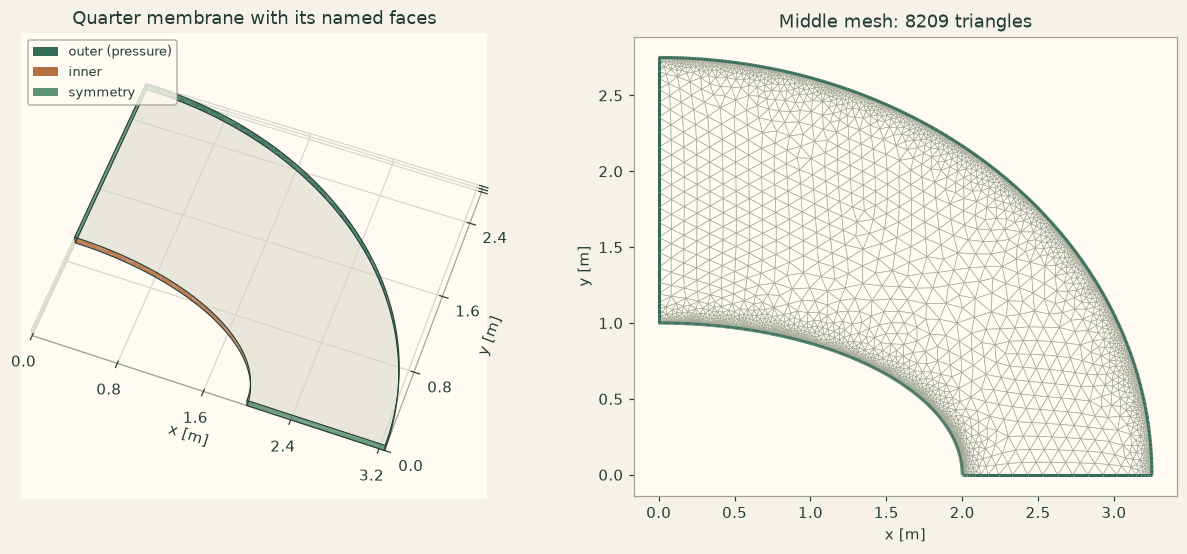
The notebook starts at the import of the CAD file elliptic_membrane_le1.step: STEP (AP242), readable by any CAD program, with the names of the faces that the boundary conditions use. Put it next to the notebook.
The geometry script
The script elliptic_membrane_le1_geometry.py builds the geometry with the CAD objects of OneSimulation and writes the file. Change a dimension there, run it, and run the notebook again.
"""Geometry of the OneSimulation example "Elliptic membrane under outward pressure (NAFEMS LE1)".

Builds the quarter of the elliptic membrane (inner edge the ellipse with half axes 2 m x 1 m,
outer edge 3.25 m x 2.75 m, 0.1 m thick) with the CAD objects of OneSimulation and writes
elliptic_membrane_le1.step. The faces are named inner, outer, symmetry_x and symmetry_y.
"""

from onesim.cad.d2 import Profile
from onesim.cad.d3 import Box, Prism

inner, outer, thickness = (2.0, 1.0), (3.25, 2.75), 0.1
ring = Prism(
    profile=Profile.ellipse(*outer, name="outer").with_holes(
        Profile.ellipse(*inner, name="inner")
    ),
    height=thickness,
)
membrane = ring & Box(length=4.0, width=4.0, height=thickness)
membrane = membrane.grouped(
    symmetry_x=membrane.boundaries["part.x_min"],
    symmetry_y=membrane.boundaries["part.y_min"],
)
membrane.save("elliptic_membrane_le1.step")
The notebook
The complete notebook, cell by cell. Run it to produce the figures and the comparison printout.
The membrane is a thin elliptic ring: the inner edge is the ellipse \((x/2)^2+(y/1)^2=1\), the outer edge the ellipse \((x/3.25)^2+(y/2.75)^2=1\) (metres), the thickness is 0.1 m. A uniform outward pressure of 10 MPa acts on the outer edge. Because of symmetry only the quarter \(x\ge0,\ y\ge0\) is modelled, in plane stress.
The quarter comes from the CAD file elliptic_membrane_le1.step, which names its faces; the script elliptic_membrane_le1_geometry.py builds it with the CAD objects of OneSimulation.
| boundary | condition |
|---|---|
| \(x=0\) | \(u_x=0\) |
| \(y=0\) | \(u_y=0\) |
outer | normal traction \(+10\) MPa (outward) |
inner | traction free |
Steel with \(E=210\) GPa and \(\nu=0.3\).
Reference. NAFEMS, The Standard NAFEMS Benchmarks, rev. 3 (1990), test LE1: the hoop stress at point \(D=(2,0)\), at the end of the long axis of the inner ellipse, is \(\sigma_{yy}=92.7\) MPa.
import numpy as np
from onesim.cad.exchange import load
from onesim.meshing import TriangularMesher
from onesim.physics.solid_mechanics import SmallStrainSolid
from onesim.visualization import plots, theme

theme.set()
Geometry and mesh
load returns the quarter with its named faces and section the mid-plane region, whose sides keep the names of the faces they were cut from. The mesher follows the two ellipses with short boundary segments; three meshes with interior cells of 0.2, 0.1 and 0.05 m grade away from them.
membrane = load("elliptic_membrane_le1.step")
faces = membrane.boundaries
inner, outer, thickness = (2.0, 1.0), (3.25, 2.75), 0.1
region = membrane.section((0, 0, 1), origin=(0, 0, thickness / 2))
sides = region.boundaries
sizes = [0.2, 0.1, 0.05]
meshes = [
    TriangularMesher(
        target_size=size, grading=0.25, local_sizes={"inner": size / 3}
    ).generate(region)
    for size in sizes
]

fig = plots.figure(1, 2, size=(14, 5.5))
plots.geometry(
    membrane,
    selection={
        "outer (pressure)": faces.outer,
        "inner": faces.inner,
        "symmetry": faces.symmetry_x | faces.symmetry_y,
    },
    labels=False,
    camera=plots.Camera(elevation=60, azimuth=-70),
    title="Quarter membrane with its named faces",
    ax=fig[0],
)
plots.mesh(
    meshes[1],
    groups=("all",),
    legend=False,
    title=f"Middle mesh: {meshes[1].cell_count} triangles",
    ax=fig[1],
)
plots.show()
Model
The outward pressure is a traction along the normal of the outer ellipse, \(p\,\mathbf n\) with \(\mathbf n\propto(x/a^2,\,y/b^2)\). The same model is solved with linear and with quadratic triangles on the three meshes.
pressure = 10e6
steel = SmallStrainSolid(
    youngs_modulus=210e9,
    poisson_ratio=0.3,
    kinematics="plane_stress",
    thickness=thickness,
)
outward = (
    lambda x, y: pressure
    * np.stack((x / outer[0] ** 2, y / outer[1] ** 2), axis=-1)
    / np.hypot(x / outer[0] ** 2, y / outer[1] ** 2)[..., None]
)
runs = {
    (order, size): steel.solve(
        mesh=mesh,
        times=(0.0,),
        order=order,
        tractions=((sides.outer, outward),),
        displacements=(
            (sides["part.x_min"], "x", 0.0),
            (sides["part.y_min"], "y", 0.0),
        ),
    )
    for order in (1, 2)
    for size, mesh in zip(sizes, meshes)
}
Results
The hoop stress follows from Hooke's law for plane stress with the gradient of the displacement field, evaluated exactly at point D.
hoop = (
    lambda result, points: 210e9
    / (1 - 0.3**2)
    * (lambda g: g[:, 1, 1] + 0.3 * g[:, 0, 0])(
        result.space.gradient(result.displacement[0], np.atleast_2d(points))
    )
)
target = 92.7
at_d = {key: hoop(result, (inner[0], 0.0))[0] / 1e6 for key, result in runs.items()}
print(
    "elements             cell size [m]   triangles   σ_yy at D [MPa]   deviation from 92.7 MPa"
)
for (order, size), value in at_d.items():
    print(
        f"{['linear', 'quadratic'][order - 1]:20s} {size:13.3f} {meshes[sizes.index(size)].cell_count:11d} "
        f"{value:17.2f} {100 * (value / target - 1):+14.2f} %"
    )
Figure
The hoop stress in the quarter on the finest quadratic mesh, the hoop stress along the symmetry line \(y=0\) from D to the outer edge, and the mesh study at D for both element orders.
mesh, result = meshes[-1], runs[2, sizes[-1]]
x = np.linspace(inner[0], outer[0], 120)
fig = plots.figure(1, 3, size=(18, 5.5))
plots.heatmap(
    mesh.coordinates[:, 0],
    mesh.coordinates[:, 1],
    hoop(result, mesh.coordinates) / 1e6,
    triangles=np.asarray(mesh.cells),
    limits=(-10, 95),
    label="σ_yy [MPa]",
    title="Hoop stress σ_yy",
    ax=fig[0],
)
plots.line(
    points={
        "linear triangles": (
            x[::4],
            hoop(runs[1, sizes[-1]], np.column_stack((x, 0 * x)))[::4] / 1e6,
        )
    },
    y={"quadratic triangles": (x, hoop(result, np.column_stack((x, 0 * x))) / 1e6)},
    hlines={"NAFEMS target at D": target},
    xlabel="x on the line y = 0 [m]",
    ylabel="σ_yy [MPa]",
    title="Hoop stress from D to the outer edge",
    ax=fig[1],
)
plots.line(
    [mesh.cell_count for mesh in meshes],
    {
        f"{name} triangles": [at_d[order, size] for size in sizes]
        for order, name in ((1, "linear"), (2, "quadratic"))
    },
    hlines={"NAFEMS target 92.7 MPa": target},
    markers=True,
    xlabel="triangles",
    ylabel="σ_yy at D [MPa]",
    title="Mesh study at point D",
    legend="lower right",
    ax=fig[2],
)
plots.show()
Going further
Change the half axes in elliptic_membrane_le1_geometry.py and write the STEP file again, or compare the plane-stress answer with the thick-plate variant of the benchmark (LE10), which has the same outline and bends under a pressure on its face.